





The build-versus-buy debate on AI has been asked the wrong way. The question shouldn’t be whether to build, but rather twofold:
- Where does custom code create an advantage that a platform can’t?
- Where does custom code become an anchor you can’t afford?
In conversations I’ve had with ServiceNow customers about how AI is reshaping decisions, work, and risk, five priorities consistently come up regardless of industry: business alignment, cybersecurity, operationalizing AI, technology governance, and workforce transformation. Those priorities should factor into every AI investment decision because they point to where custom capability pays off and where it doesn't.
Custom capability can serve business priorities in domain models built on open-weight and frontier-model foundations. Intelligent experiences that create competitive stickiness are another example, as are governance frameworks for AI risk and budget management that you control end to end. Start with strategic value. Domain models, intelligent experience, and the agility to keep innovating form a moat that lasts.
A financial services firm that builds intelligent onboarding experiences guides customers through complex journeys and reveals valuable options that competitors can’t. That’s differentiation. A retail company that builds domain models to power dynamic pricing and personalized promotions produces margin advantage that it owns. Deploy your best minds to these kinds of projects.
AI talent is scarce. Where you deploy it matters more than how much of it you have. Successful teams build AI grounded in the business context and their specific risk and governance requirements. They discover unit economics redefined by AI's ability to offload cognitive weight from manual decision-making. They reimagine pricing and packaging in ways AI makes possible.
That’s a tall order in depth and breadth of execution. Talent capable of doing that at scale exists in limited supply. That scarcity is exactly why it should be deployed on your highest-value problems, not everywhere at once.
Model prices drop monthly. New capabilities emerge on a similar clock. Custom architecture has to absorb that pace without breaking. That means building evals and AI harnesses with ablation coding to experiment and swap models as the technology moves, along with access controls for AI agents and humans working at scale. Design verification loops within the deterministic testing harness.
A manufacturer deploying AI vision systems for real-time defect detection can’t be locked into one model. New vision models arrive monthly. Because the manufacturer's architecture was built to absorb advances rather than depend on any single model, it integrates each one without rewriting the quality pipeline. That agility is the competitive advantage.
AI ecosystem innovation moves faster than the historic lifecycle of custom code. Solutions that used to live 10 to 20 years now live two to three.
Building financial discipline into your AI program and pairing it with change management that captures AI-driven gains in chief financial officer (CFO) metrics changes what happens at the two-year mark. When you get a re-platforming ask, it’s easy to make the case for it because the AI-driven gains you’ve already measured provide the funding for the new project.
A governance framework built to adapt at both design time and run time lets an organization own the risk of evolving regulations instead of being owned by it.
A healthcare organization deploying AI for clinical decision support, for example, requires governance frameworks that manage development spend, inference costs, and evolving regulatory oversight simultaneously.
The Health Insurance Portability and Accountability Act (HIPAA), U.S. Food and Drug Administration (FDA) pathways, and clinical regulations shift under an AI program in healthcare.
The same discipline that identifies where to build also identifies where not to (see table).
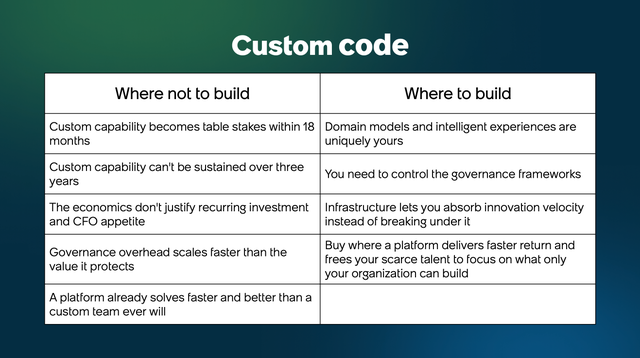
Both paths demand the same rigor. Both have to earn their return on investment on the same terms. That discipline, applied consistently rather than argued case by case, is how organizations move fast on AI and win.
Find out how ServiceNow can help you build AI-powered apps.