


Now is IT’s moment. That was the message behind every keynote, breakout, and customer story at Knowledge 2026.
It wasn’t just because IT got a flashy demo, but because the agentic playbook that ServiceNow has laid out works only if IT is running all of it: the AI agents, the governance layer, the context, and the execution. It all sits in the function most enterprises spent the last decade trying to shrink.
For years, the conversation around IT has been doing more with less. Knowledge 2026 raised a question: What does IT become when AI specialists take over the job queue, the platform supplies the context, and the team gets to spend time on the work that moves the business? We’re about to find out in this recap of the event through an IT lens.
ServiceNow expanded the Autonomous Workforce with a wave of new IT AI specialists spanning infrastructure monitoring, site reliability engineering (SRE), asset lifecycle, and strategic portfolio management.
The L1 IT Service Desk AI Specialist is now available, as is a new AIOps Specialist that can detect anomalies, correlate events, and trigger remediation autonomously. There’s also an SRE specialist that handles incident triage and postmortem documentation end to end.
Early proof of success: 99% faster IT case resolution inside ServiceNow’s own help desk and more than 90% of employee IT requests handled autonomously. IT AI specialists are expected this year.
ServiceNow Otto combines the intelligence of Now Assist, Moveworks (now ServiceNow EmployeeWorks), and AI Experience, giving employees, partners, and customers a single destination to make requests and let the platform handle the rest.
Generally, enterprise AI has a completion problem. Models can answer questions, but they can’t finish work because they aren’t connected to the approval chains, permissions, audit trails, and cross-system workflows that the enterprise runs on. Otto is built to fill that gap.
Otto sits across the enterprise rather than inside a single app. It understands intent, routes work to the correct agent, and executes it to completion—each action governed through the ServiceNow AI Control Tower.
For IT, that’s the experience layer the AI specialists plug into. EmployeeWorks is the first product where Otto is live. Just one month after launch, it’s generated six deals worth more than $1 million in net new annual contract value, an early signal that when AI finishes work, adoption follows.
The ServiceNow AI Platform Australia release powered every IT announcement at Knowledge. Australia moves the AI Control Tower narrative beyond governance into execution.
Context Engine maps every person, role, asset, service, and policy in real time. Workflow Data Fabric connects AI to data wherever it lives. And the Configuration Management Database (CMDB) grounds every decision in operational reality. These are what AI specialists need to make decisions you trust in your environment.
ServiceNow Action Fabric may have been the announcement that will change IT architecture the most. It opens ServiceNow’s full system of action to any AI agent—whether built on ServiceNow, Claude, Copilot, or your own homegrown stack—through a generally available model context protocol server.
A password reset that once required an IT pro to manage via the ServiceNow interface can now be triggered through Claude. An employee onboarding workflow can start from any collaboration tool and still follow the same approvals, policies, and audit trails. The agent layer becomes pluggable; the workflow layer stays governed.
AI Control Tower now extends across Microsoft Agent 365 and the broader ecosystem, giving IT leaders a single place to discover, approve, and monitor every operating AI agent.
ServiceNow AI specialists also enter the Microsoft Agent 365 Marketplace as digital workers, with defined roles, permissions, and metered usage tracked across both platforms. For IT teams managing AI sprawl across vendors, this is the discovery and accountability layer that’s been missing.
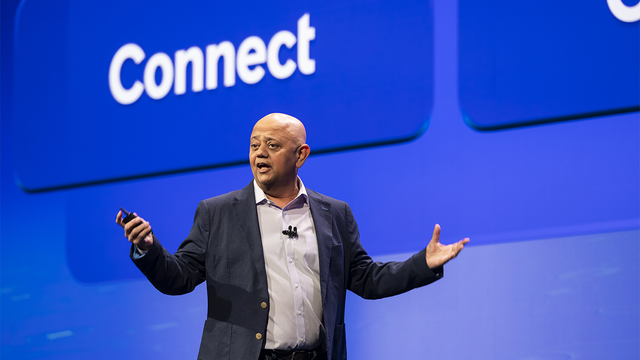
Gaurav Rewari, executive vice president of data and analytics, framed Context Engine as the “embedded, always-on AI analyst." Every IT leader has watched a pilot AI deployment stall the moment it had to make a decision without the business context to back it. Context Engine, Workflow Data Fabric, and CMDB working together move AI from an interesting demo to something you would let touch production.
Every customer who got on stage framed governance as the reason they could deploy AI specialists at speed. Most IT leaders already know this. The AI rollout that stalls is the one where security, compliance, and IT ops weren’t in the room from day 1.
- AIOps—predictive ITOps to AI agents: Learn how ServiceNow intelligent IT operations use AI, machine learning, and automation to proactively manage and optimize IT systems. This includes anticipating issues, automating routine tasks such as patching and incident routing, and resolving problems autonomously.
- Meet the SAM and HAM AI operations specialists: When leadership approves a strategic expansion of AI engineers, the impact hits fast. New headcount, hardware, software, and infrastructure must be scaled overnight. Watch IT asset management admins work alongside their AI specialists to fulfill laptops, servers, licenses, and entitlements before day 1.
- Scaling autonomous IT: Lessons from Docusign: This is a powerful story about what it takes to deploy AI specialists across high-volume IT workflows.
If you take only one thing away from this recap, it should be this: The IT operating model for the agentic era is fundamentally different from the one we’ve had until now. The future will have AI specialists proactively working in the job queue, with context and governance delivered from the AI platform, and every agent will be accounted for. That’s the blueprint for the future of IT.
Find out how ServiceNow can help reinvent your IT.